A new book by Justin Johnson
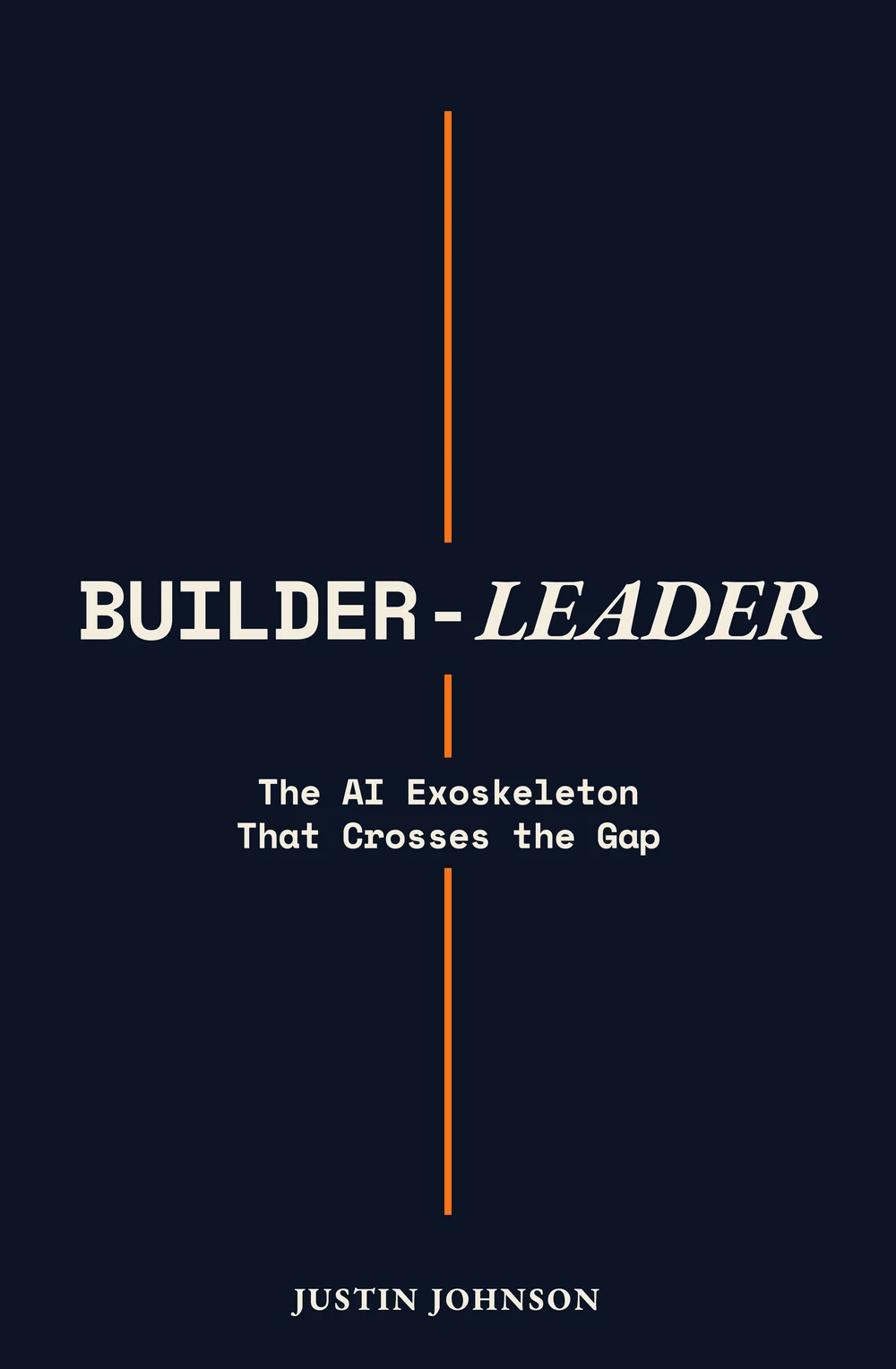
Builder-Leader
The AI Exoskeleton That Crosses the Gap.
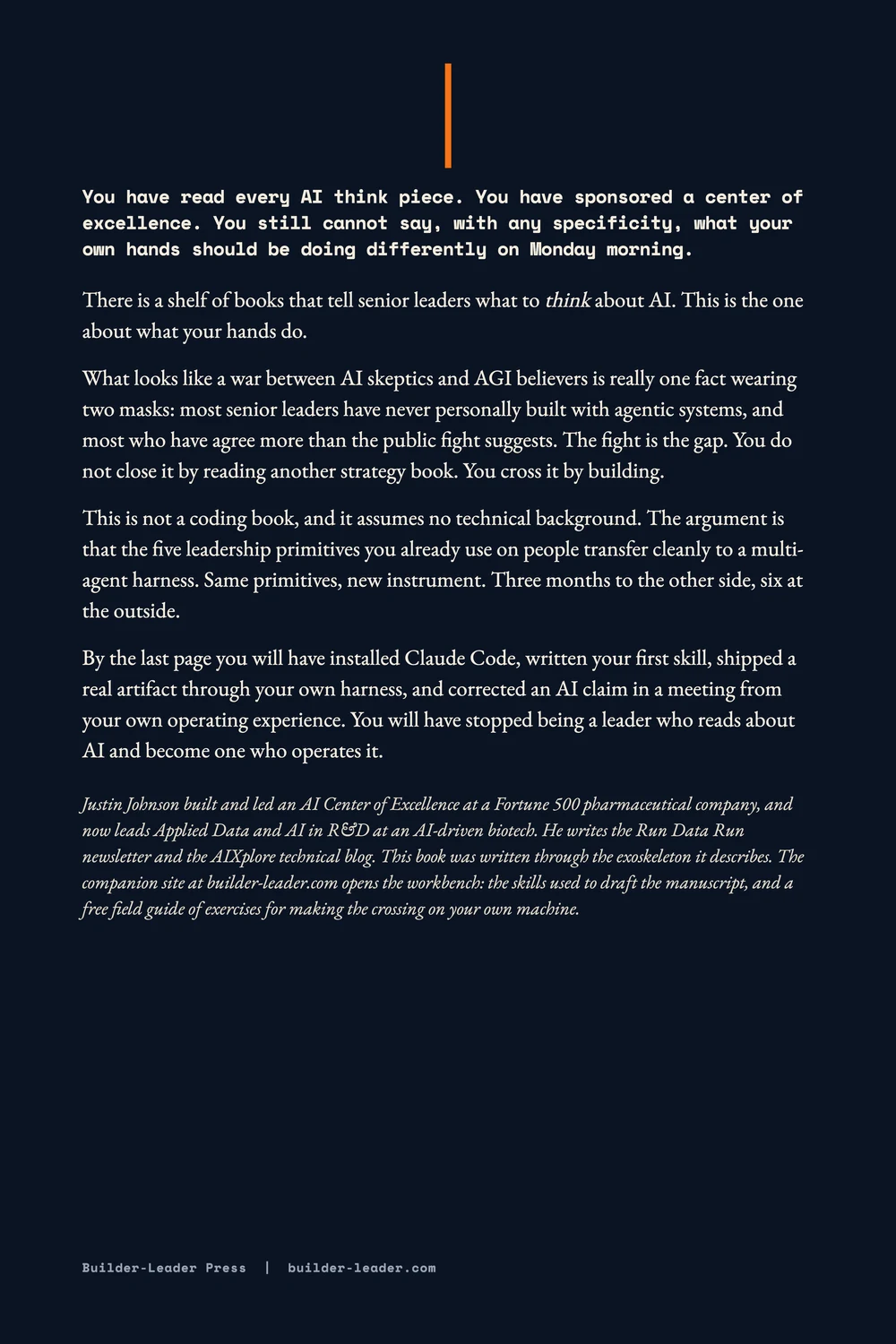
An operator's manual for the executive who knows AI matters and doesn't yet know what to personally do about it on Monday morning. Three months on target. Six on the outside.
We'll email you the moment it ships. No newsletter, no spam.
Watch the trailer
Thirty-eight seconds across the gap.
The thesis
The AI conversation isn't a fight between factions. It's a gap between two populations.
People who have built with agentic AI systems, and people who have only read about them. The two groups disagree more loudly than they should because they aren't in the same conversation. The skeptic case for the chat era is right. It just isn't the era anymore.
You cannot read your way across the gap. You cannot delegate across it. You cannot procure your way across. You cross by building, with Claude Code, with your own skills, with a harness you operate yourself.
The last page is a welcome to the community of operators who were already on the other side when you started.
Who this book is for
Senior leaders who already know AI matters, and don't yet know what to do with their own hands.
You sponsor an AI center of excellence, you've watched your org pilot ChatGPT, and you still don't know what your hands should be doing differently on Monday.
Your portfolio is wide, your daily-decision density is high, and the AI capability inside your seat is the load-bearing question. Not whether to adopt. How.
You move fast and your team is small enough that the executive who can personally direct a harness is a multiplier the org chart hasn't priced in yet.
Read the preface
A weekend, five artifacts, zero lines of code typed.
The preface opens on a specific weekend in April 2026 where the author shipped five artifacts in two days, none of them by typing code himself. It names what changed, why most readers haven't crossed yet, and what three months of operating practice actually does to your work.
Or listen (12 min)
Generated this morning with the same harness the book is about. I do not normally wake up and produce audiobooks for work. That is sort of the point.
"The bottleneck has moved from 'can the system build it' to 'can I review and redirect fast enough.' That is a very different bottleneck, and I do not know where it ends."
For readers
The book ships with three reader companions, free.
Do the exercises
Chapter-by-chapter practical work, in your own terminal, on your own files. Start with the fifteen-minute self-audit or the one-hour Chapter 6 on-ramp.
Read the source
Practitioners, skeptics, and exec-translation writers the book pays attention to. Subscribing to the practitioner shortlist takes ten minutes.
Go deeper
A curated reading list of the load-bearing primaries behind the book — papers, posts, and posts-of-record. Skip the translations; read the source material.
Behind the book
The book was built through the framework it describes.
Every chapter draft, research sweep, and revision pass was directed through a project-local Claude Code harness. The seven skills are open. Read them, fork them, or use them on your own writing.
Where to start
If you read nothing else here, take the fifteen-minute self-audit.
Field Guide 01. Four short sections. You walk away knowing which side of the build gap you are on, and the specific first action to cross it.