The book
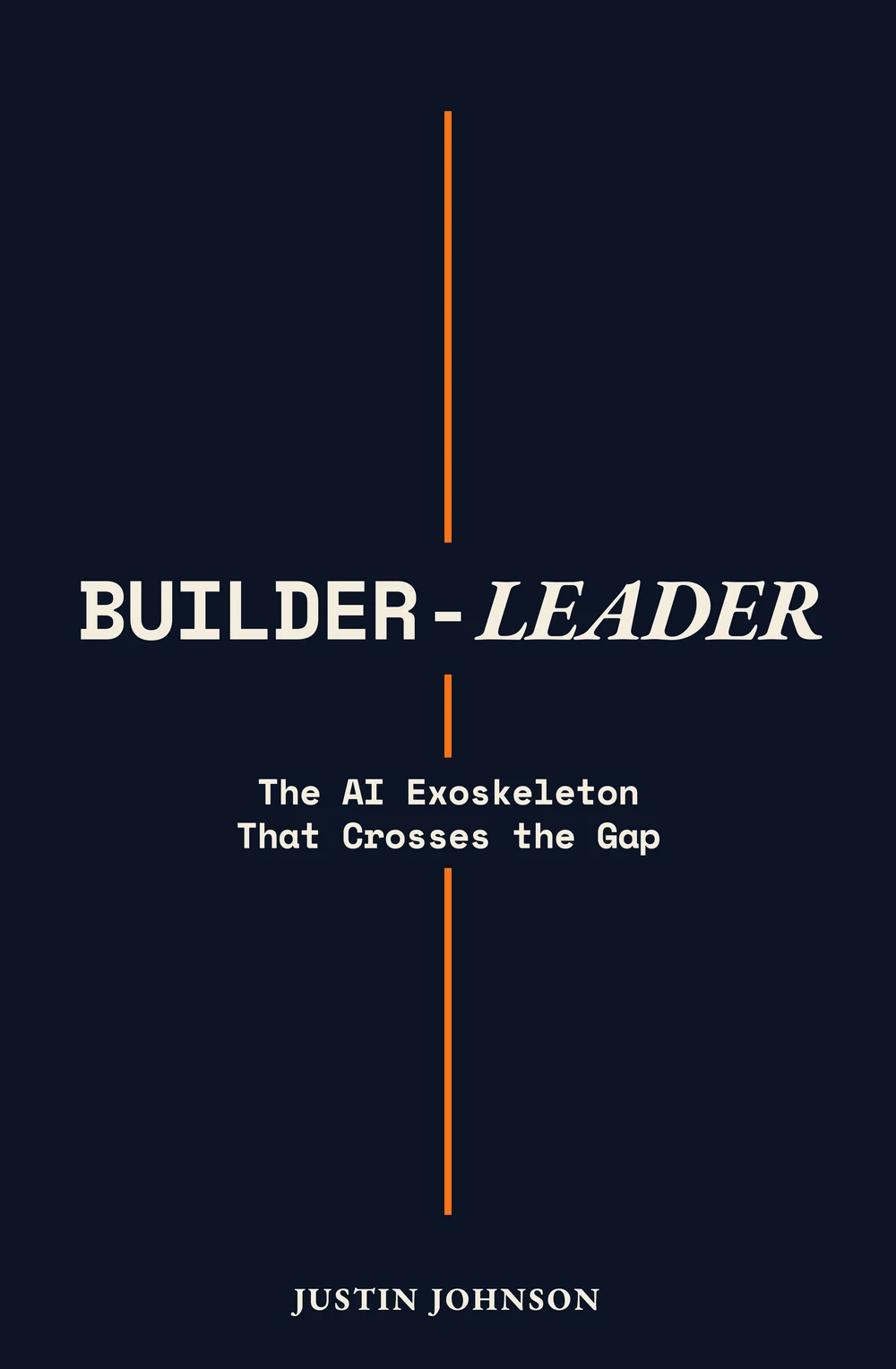
Builder-Leader
The AI Exoskeleton That Crosses the Gap
An operator's manual for the senior executive who already knows AI matters and does not yet know what to personally do about it on Monday morning. Short enough to finish over a week of commutes. Sharp enough to quote in a board meeting. Honest enough to argue against two popular positions at once: that AI is just a chatbot, and that AI is an imminent superintelligence.
By the end of the book the reader has installed Claude Code, shipped something through their own harness, and knows why their existing leadership capital compounds with the new practice rather than getting replaced by it.
Who this book is for
Senior executives who don't code, have read the AI think pieces, and still need a practical first move.
The reader qualifier is surface area times daily-decision density, not title. Core reader: F500 ED / VP / SVP; mid-cap C-minus-1 and up; founders and senior execs at startups. F500 CEO / CFO / COO tier is explicitly outside scope — at that altitude, augmented leadership is the correct frame. The book engages that counter-position fairly in Chapter 9.
The book draws heavily from a coherent intellectual tradition: Karpathy, Mollick, Fowler, Anthropic's research posts, the operator community on X and HN. Counter-traditions are engaged where they make load-bearing arguments.
Table of contents
A three-act ladder.
Preface — Welcome from the other side
Two Groups Speaking Past Each Other
What You See From the Other Side
Why Your Org Can't Cross Institutionally
The Harness and What's In It
The Builder Inside
Start With Claude Code
Building Your Personal Harness
From One Operator to a Team
Leading From the Other Side
Epilogue — Welcome
Reading sample
The preface, in full.
Roughly 1,800 words. The setup of the book in the author's voice, with the central claim and the friction the reader will run into named directly. Read it before you decide whether the book is for you.
Or listen to it
12 minutes. Generated this morning with the same harness the book is about: chunked, narrated through Gemini's Flash TTS, mastered, stitched, and shipped before breakfast. I don't normally wake up and produce audiobooks for work. That is sort of the point.
"Two years ago, my kids showed me a website called 11:11 Make a Wish. You typed a wish at 11:11 and the site would hold it for you. They loved it. I loved that they loved it. So I decided to make my own version for the App Store. I called it 11:11 Make a Fish. A fish, because fish were funnier than wishes to an eight-year-old. It took me the better part of two weeks."
"This weekend, in April 2026, I did five things. I started writing this book. I wrote a blog post explaining a machine learning system we built for estimating which genetic variants cause cancer in patients. I produced the complete DNA sequence analysis pipeline that blog post describes, not as a demo but as the real thing. I shipped a commercial domain discovery tool called Nymio, built across a multi-model backend, one weekend from nothing to a working product. And I built a multi-agent portfolio system that would previously have been a multi-month engineering effort."
"I did not write any of the code."
From the preface of Builder-Leader: The AI Exoskeleton That Crosses the Gap.
Get the book
On Amazon now.
The Kindle edition and the paperback are on Amazon. Hardcover and the author-narrated audiobook follow later in 2026.
Get it on Amazon →